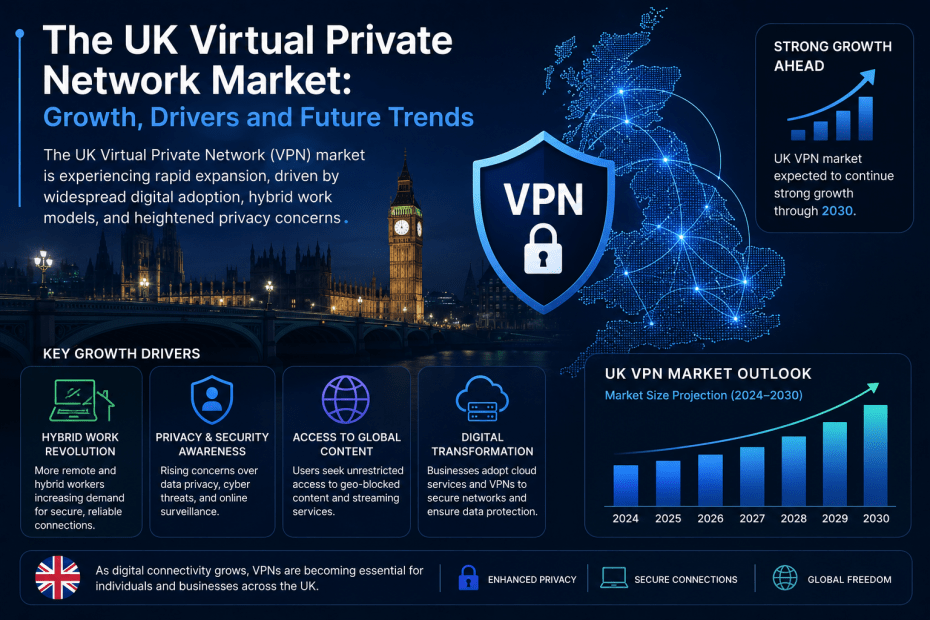
The UK Virtual Private Network (VPN) market is experiencing rapid expansion, driven by widespread digital adoption, hybrid work models, and heightened privacy concerns .
The UK virtual private network (VPN) market has expanded significantly in recent years, moving beyond a niche technology to become an essential tool for both businesses and consumers. Valued at $12.9 billion, it is forecast to reach $32.7 billion by 2031, growing steadily at a compound annual growth rate (CAGR) of 16.5%. This rise reflects broader shifts in digital behaviour, including hybrid working practices, rising privacy concerns, and the impact of new government regulations.
The Regulatory Catalyst: How Government Legislation Boosted VPN Demand
One of the most notable recent drivers behind the surge in VPN adoption in the UK has been the implementation of the Online Safety Act. The legislation introduced stricter age verification requirements and content controls on social media and other online platforms. These measures have inadvertently encouraged many consumers to seek privacy tools, including VPNs, to maintain anonymity and circumvent restrictions.
Google Trends data indicates a 427% increase in UK search interest for VPNs following the enforcement of the Online Safety Act. This surge was accompanied by a 40% sustained increase in VPN traffic relative to pre-legislation levels, as reported by independent Ofcom monitoring. The public’s curiosity about the legality and implications of VPN use also soared, with breakout search terms such as “are VPNs legal” and “will the UK ban VPNs” growing by over 5,000%.
This spike reveals a complex picture: while many users turn to VPNs for privacy, others are motivated by a desire to bypass perceived restrictions or regain access to content. However, it is important to note that VPNs remain legal in the UK, provided they are not used for illegal activities.
Consumer and Enterprise Adoption: Different Drivers, Shared Growth
VPN adoption is no longer confined to tech enthusiasts or corporate environments. According to YouGov data featured by TheBestVPN, 47% of UK adults have used a VPN at least once. This figure is more than double the global average of 23.1%, highlighting the UK’s heightened awareness of online privacy and security.
The demographic breakdown reveals that 54% of British men use VPNs, compared with 41% of women, suggesting a gender gap in privacy tool adoption. Among consumers, the main reasons for using VPNs include protecting data on public Wi-Fi networks, accessing international streaming libraries, and circumventing geo-restrictions.
On the corporate side, VPNs underpin the remote working infrastructure for most large organisations. Approximately 93% of large UK enterprises depend on VPNs or secure remote access systems to support hybrid workforces. These solutions form the financial backbone of the market, with many firms evolving their VPN use towards integrated models such as Secure Access Service Edge (SASE) and Zero-Trust Network Access (ZTNA). These approaches prioritise continuous identity verification rather than relying solely on perimeter-based security, reflecting growing concerns about sophisticated cyber threats.
Meanwhile, small and medium-sized businesses (SMBs) are increasingly investing in cost-effective cloud-based VPN services, including IPsec and zero-trust models, to safeguard distributed teams. This segment is growing faster than traditional hardware-based VPN solutions, expanding at an annual rate of 17.4%.
Future Outlook: Continued Expansion and Evolving Technology
Looking ahead, the UK VPN market is expected to nearly triple in value, hitting $32.7 billion by 2031. This growth will be driven by ongoing digital adoption, regulatory developments, and the transition to more sophisticated VPN architectures.
The shift from classical VPN tunnels to integrated SASE frameworks and zero-trust systems marks a significant evolution. These technologies combine network security with identity management, offering more granular control over access and reducing vulnerabilities. This matters because conventional VPNs can struggle to cope with the complexity of modern cyberattacks and hybrid work environments.
For everyday users, VPNs will likely remain popular tools for privacy and content access. For enterprises, the challenge will be balancing security, usability and cost as they upgrade their infrastructure. While the market outlook is positive, users should remain aware of potential trade-offs, including speed reductions and the need for careful configuration to avoid security gaps.
FAQs About the UK VPN Market
1. Why has VPN usage increased so much in the UK recently?
The rise in VPN use has been influenced by multiple factors, including the enforcement of the Online Safety Act, which led to greater public interest in privacy tools. Additionally, hybrid working and growing privacy concerns have encouraged both consumers and businesses to adopt VPNs.
2. Is using a VPN legal in the UK?
Yes, using a VPN is legal in the UK. However, it is illegal to use a VPN for activities that break the law, such as accessing illegal content or committing fraud. The surge in searches about VPN legality reflects public uncertainty following recent regulations.
3. How do enterprise VPNs differ from consumer VPN services?
Enterprise VPNs often support secure remote access for large workforces, integrating with identity management and security policies. Consumer VPNs typically focus on privacy, streaming access and protection on public Wi-Fi. The market is seeing growth in cloud-based services for both sectors.
4. What is Zero-Trust Network Access and why is it important?
Zero-Trust Network Access (ZTNA) is a security model that requires continuous identity verification before granting access to resources. Unlike traditional VPNs that trust users once connected, ZTNA limits access strictly based on verified identity, improving protection against cyber threats.
5. Will VPN technology continue to evolve in the UK?
Yes, VPN technology is evolving rapidly with trends towards integrated security models like SASE and ZTNA. These changes aim to address the complexities of remote work and sophisticated cyberattacks, ensuring VPNs remain relevant and effective.