When it comes to online security, the terms “VPN” and “firewall” often pop up, sometimes used interchangeably or confused with one another. But in reality, these two tools serve different purposes and protect you in distinct ways. Understanding what each does can help you decide if you need one, the other, or both. Let’s break it down.
What Exactly Is a VPN?
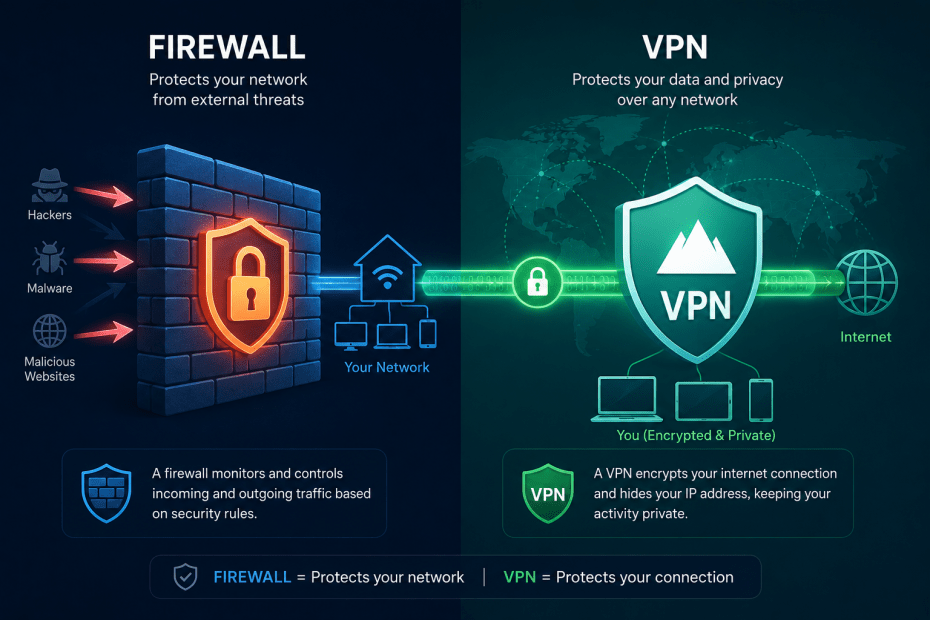
A VPN, or virtual private network, acts like a secure tunnel between your device and the internet. Instead of connecting directly to a website or service, your traffic is routed through a VPN server. This rerouting masks your IP address and encrypts your data, making it much harder for anyone—hackers, advertisers, or even your internet service provider—to see what you’re up to online.
Think of it like sending a letter inside a locked box rather than on a postcard anyone can read. For example, if you’re on public Wi-Fi at a café, a VPN can prevent snoopers on the same network from intercepting your personal details or passwords.
What Does a Firewall Do?
Where a VPN focuses on privacy and data encryption, a firewall acts as a gatekeeper, monitoring and controlling incoming and outgoing network traffic based on security rules. It’s like a security guard stationed at the entrance of a building, checking who’s allowed in or out.
Firewalls can be hardware devices or software programs built into your computer or router. Their job is to block suspicious or malicious traffic—like hackers trying to access your device or unwanted programs attempting to communicate with outside servers. For example, if malware tries to send your data back to its creator, a firewall might stop that connection before any damage happens.
How VPNs and Firewalls Overlap
Although VPNs and firewalls serve different roles, they do overlap somewhat in their goal to protect you online. Both can prevent unauthorized access and help keep your data safe. However, a firewall doesn’t hide your location or encrypt your internet activity, and a VPN doesn’t actively block incoming threats or monitor traffic for suspicious behavior.
Imagine you’re driving through a neighborhood. The VPN is like traveling in a tinted, armored car that hides you and your passengers from prying eyes, while the firewall is the neighborhood’s security gate that only lets known and trusted visitors in and keeps troublemakers out.
Do You Need Both a VPN and a Firewall?
For most people, the answer is yes—using both can give you a stronger, layered defense. A VPN protects your privacy by encrypting your data and masking your IP address, which is especially useful on public Wi-Fi or when you want to bypass geo-restrictions. Meanwhile, a firewall continuously monitors traffic and blocks malicious attempts to access your device or network.
Relying on just one leaves gaps. Without a firewall, your device might still be vulnerable to certain attacks, even if your VPN encrypts your data. Without a VPN, your data could be exposed to your ISP or hackers if you’re on an unsecured network.
That said, certain firewalls come with built-in VPN options, and some VPN services include firewall features, blurring the lines between the two. But understanding their core differences helps you choose the right tools for your needs.
Practical Examples: Using Both in Everyday Life
Imagine you’re working remotely while traveling. You connect to a hotel’s public Wi-Fi to check sensitive work emails. A VPN encrypts your traffic so nosy neighbors on the network can’t snoop. Meanwhile, your firewall blocks any unexpected incoming connections that might try to spy on your device.
Or consider a family with kids using the home network. The firewall can block known malicious sites and suspicious apps from sending or receiving data, while a VPN could be used by a parent to privately browse or access content that’s restricted in their country.
Conclusion
Both VPNs and firewalls play important but distinct roles in online security. VPNs focus on privacy and data encryption, keeping your browsing activities private and protecting your identity online. Firewalls serve as gatekeepers, monitoring and blocking potentially harmful traffic before it reaches your device.
Using both together creates a more comprehensive shield against security threats and privacy invasions. While a VPN guards your data from prying eyes, a firewall keeps unwanted visitors from getting in. Depending on your online habits and security needs, layering these tools can be a smart move.
FAQs
1. Can I use a VPN without a firewall?
Yes, you can, but it’s not ideal. A VPN encrypts your data and hides your IP address but doesn’t actively block malicious traffic. Without a firewall, your device might still be vulnerable to certain types of attacks.
2. Does a firewall protect my privacy like a VPN?
No. A firewall blocks unauthorized access and malicious traffic but doesn’t encrypt your data or hide your IP address. For privacy protection, a VPN is necessary.
3. Are VPNs and firewalls free?
There are free versions of both, but they often come with limitations. Paid VPNs and firewalls typically offer better security, faster speeds, and more features.
4. Can a VPN replace a firewall on my device?
Not really. A VPN and firewall serve different purposes, so using one instead of the other can leave your device at risk. Ideally, use both for better protection.
5. Do all VPNs come with built-in firewalls?
Not all. Some VPN services include firewall features, but many do not. It’s important to check what security features your VPN provider offers.
Some VPN Options for you
Nord VPN
Online VPN service that encrypts your internet traffic and hides your IP with physical location. Upgrade your privacy and security…
Trustpilot: ★★★★☆ (4.1)
Monthly Price: £11.09
Surfshark
Get Surfshark and stay protected. 3200+ servers worldwide. Unlimited devices. Audited: No-logs VPN. RAM-only servers. 24/7 support.
Trustpilot: ★★★★☆ (4.3)
Monthly Price: £11.99
Pure VPN
A VPN service helps you break free from location restrictions – so you can enjoy more of what you love.…
Trustpilot: ★★★★☆ (4.3)
Monthly Price: £12.95
IP Varnish
Help protect private information like your location data, personal identity, and browsing history when you use the internet on any…
Trustpilot: ★★★★☆ (4.6)
Monthly Price: £12.99
Cyber Ghost
With more than 7000 servers, it offers top privacy for all devices, Windows, iOS, Mac, Android, or Linux.
Trustpilot: ★★★★☆ (4.8)
Monthly Price: £10.89